Fish care & life
Drawquarium breeding: pair bonds, baby fish and what is still unknown
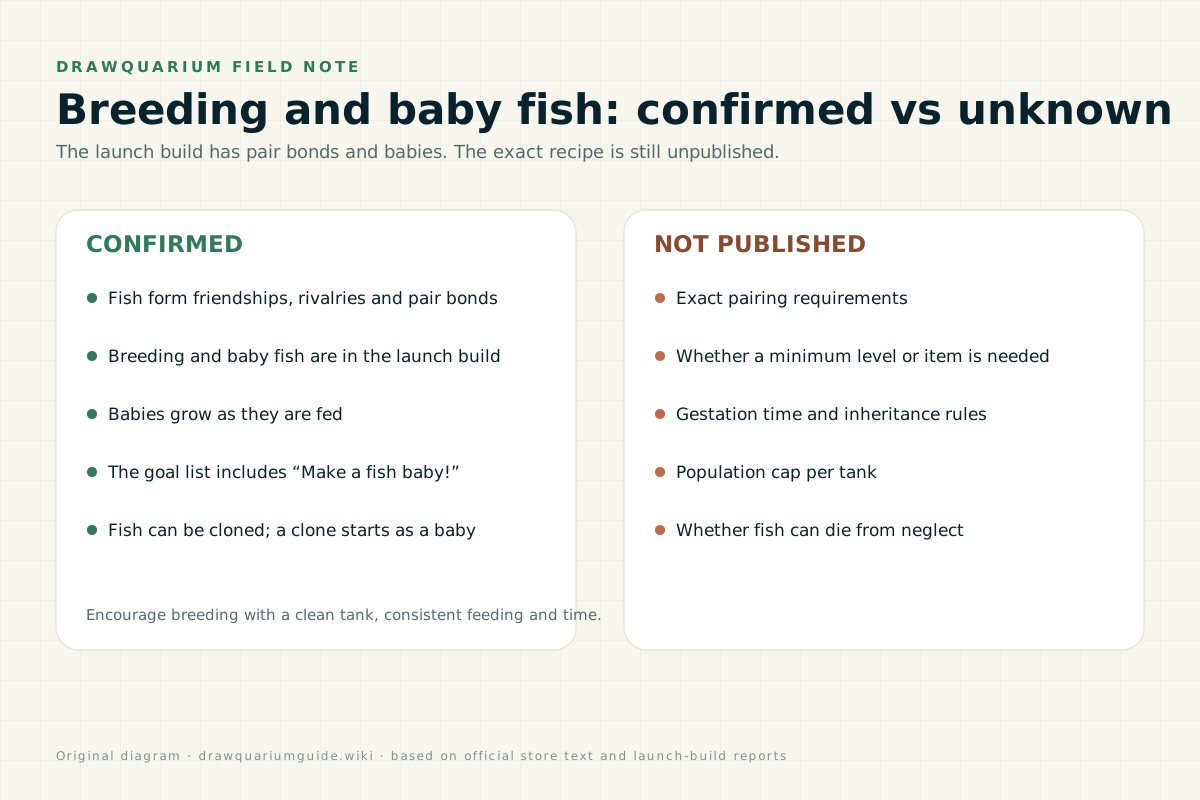
Drawquarium has pair bonds, breeding and baby fish. It does not have a published breeding recipe. This page covers what the developer and launch build confirm, and where every “feed three times” guide is guessing.
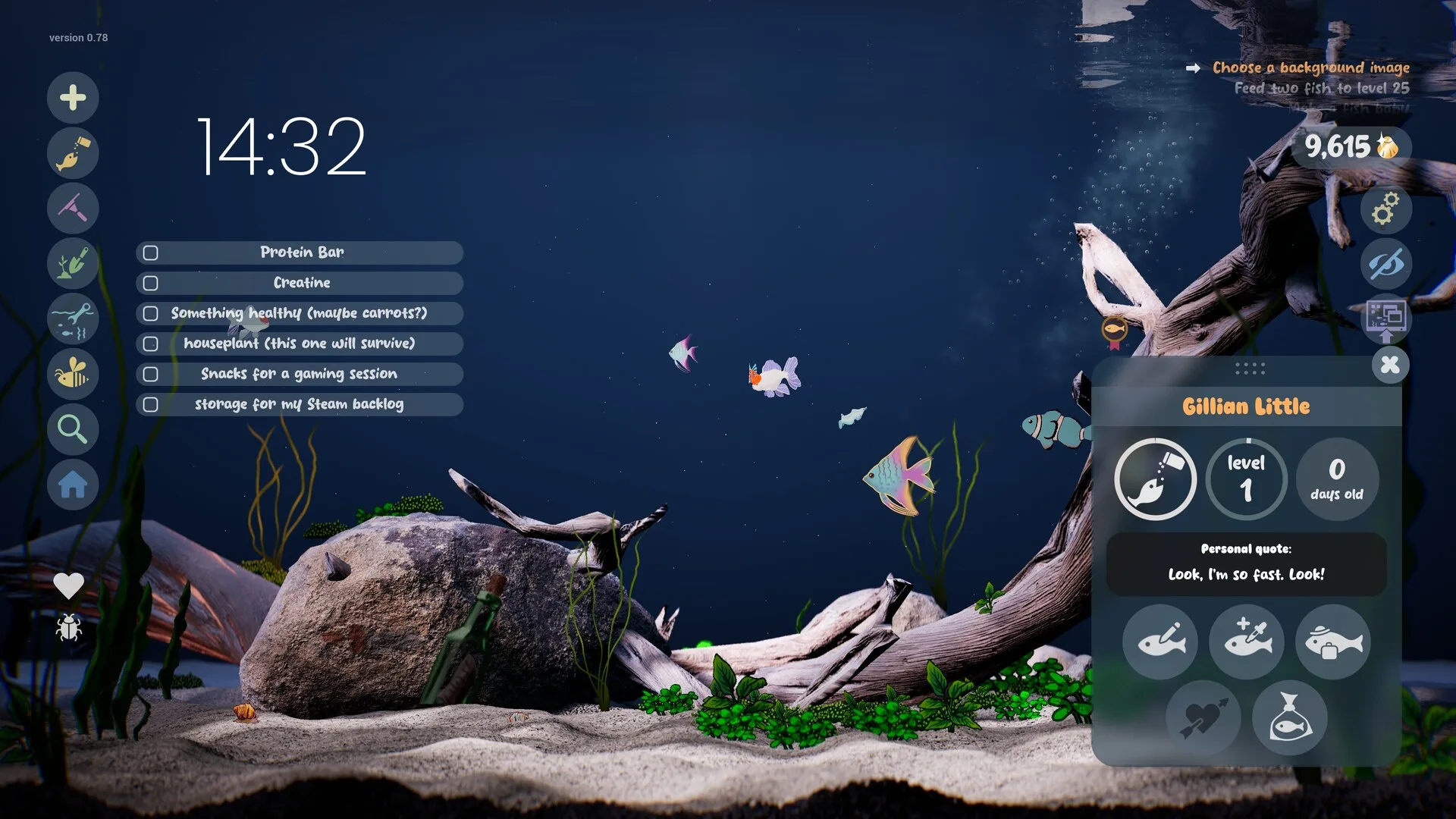
Breeding is one of the systems that makes Drawquarium more than a drawing toy. The developer’s September 2026 update lists reproduction and baby fish, and a detailed launch-day review describes fish forming relationships and eventually having babies. That confirms the system exists. It does not confirm the exact trigger.
What is confirmed
| Feature | Status |
|---|---|
| Friendships and rivalries | Confirmed |
| Pair bonds / soulmates | Confirmed |
| Breeding and baby fish | Confirmed in the launch build |
| Babies grow when fed | Confirmed |
| Exact pairing requirements | Not published |
| Colour inheritance | Not published |
How to encourage a pair
There is no official checklist, but the care systems that are documented point to a sensible approach:
- Give the fish time. Relationships are not instant; the game describes fish noticing each other and forming bonds over time.
- Keep the tank clean. Leftover food and debris persist. A neglected tank is not a neutral state.
- Feed consistently. Growth and condition improve with regular care; a starving tank is unlikely to be a breeding tank.
- Do not crowd the tank. Too many fish hide individual behaviour and make it harder to spot a pair.
- Watch who swims together. The profile card and the fish list are the best tools for following a relationship.
- Be patient. The exact trigger is unknown. Time and a stable tank are the only honest advice.
Baby fish and growth
Babies are small and grow as they are fed. A clone also starts as a baby, so the care loop is the same: feed, watch the level and age, and keep the tank clean. The profile card shows a level and age in days, but the exact growth thresholds are not published.
If you want to keep a baby, avoid moving it repeatedly. Moving fish between aquariums is supported after the tutorial, but a stable tank makes behaviour easier to read.
Why no babies yet?
- The pair may not be bonded. Friendship is not the same as a pair bond.
- The tank may be too new or too crowded. Give the fish time and space.
- Feeding may be inconsistent. Growth and condition are care-based.
- The trigger may include something unpublished. That is not a player mistake; it is a documentation gap.
- You may be looking at the wrong fish. The global fish list shows all aquariums.
Colours and inheritance
No official source describes how baby colours, patterns or body shapes are inherited. The store says fish can find a soulmate and have babies, but not whether the baby is a blend, a copy or a random variation. Treat any inheritance table as unverified until the developer publishes one or players reproduce it across multiple tanks.
Breeding vs cloning
Cloning copies one fish and starts the copy as a baby. Breeding involves two fish and a pair bond, and may mix traits. If you want an exact copy of a design, clone it. If you want the emergent relationship story, let a pair bond form. The clone guide covers the exact clone and rename rules.
Breeding FAQ
Can fish breed in Drawquarium?
Yes. The developer’s September 2026 update added breeding and baby fish, and a launch-day review describes fish eventually having babies. The exact requirements are not published.
How do I breed fish in Drawquarium?
There is no published step-by-step recipe. The confirmed ingredients are a pair bond, time and care. Keep the tank clean, feed consistently, and let compatible fish spend time together. Do not trust a guide that lists exact levels or items without evidence.
Do baby fish inherit their parents’ colours?
Not published. The game has breeding and baby fish, but the inheritance rules have not been documented. Treat colour inheritance as an open question.
Do I need a special item to breed?
Unknown. No breeding item has been listed in the store or developer FAQ. If a guide says you need one, ask for the source.
What is the difference between breeding and cloning?
Breeding creates a baby from a pair bond and may mix traits. Cloning copies one fish, but the clone starts as a baby. Both produce a baby; only breeding involves two parents.
Advertisement
Sources for this page
Checked November 16, 2026Listed claims on this page were checked against the records below. If a detail is not in these records, it is labelled as unconfirmed rather than presented as fact.
- 01 Drawquarium on Steam — Valve / byKaleb / rokaplay
Store description, release date, languages, features, requirements, tags, bundles and platform list. Checked November 16, 2026: released November 13; $9.59 with a 20% introductory offer ending November 27; Steam Deck Playable; 17 screenshots; two trailers; eight bundles; Steam Cloud, Family Sharing and single-player listed; no achievements. The page shows Very Positive (325 reviews, 98% positive).
- 02 Drawquarium has changed a LOT since the demo in May — Kaleb Lechowski (Steam announcement)
September 18, 2026 list of added and improved systems since the first demo.
- 03 Drawquarium FAQ (developer thread) — rokaplay / Steam Community (developer)
Pinned November 10, 2026 FAQ, rechecked after launch: demo fish and aquariums carry over, no achievements yet, Linux/Steam Deck not officially supported, PNG import guidance (850×850 for a big fish), no layers, pressure settings, zoom and colour shortcuts, clone instead of rename, plants unlock from a ground fish, pause while drawing if it slows down, and how to leave feeding mode.
- 04 Drawquarium customer reviews on Steam — Steam Community
Review snapshots: launch evening (21:30 UTC, November 13) was Very Positive with 100% of 57 Steam-purchaser reviews positive. On November 16 the page showed Very Positive with 98% of 325 Steam-purchaser reviews positive, 359 total including key activations and 6 negative. Reviews describe PNG import, feeding behaviours, cleaning, breeding, moving fish between aquariums, performance and multi-monitor Wallpaper Mode.
Read how we classify evidence in our editorial policy.
Quick status